
Seven questions. One path forward.
Explore the frameworks that connect circular ambition with strategy, digital capability and practical execution.
From understanding to action.
The earlier frameworks answer individual strategic questions. Together, they build toward the final challenge: how to put circularity into practice and turn it into lasting competitive advantage.
 Question 02 · Fig. 3.1What circular business opportunities exist?
 Question 03 · Fig. 4.4When should we move?
 Question 04 · Fig. 9.2How do we formulate circular strategy?
 Question 05 · Fig. 9.3Where does the economic value come from?
 Question 06 · Fig. 10.1What digital capabilities do we need?
 Question 07 · Fig. 18.1How do we put it all together and make it happen?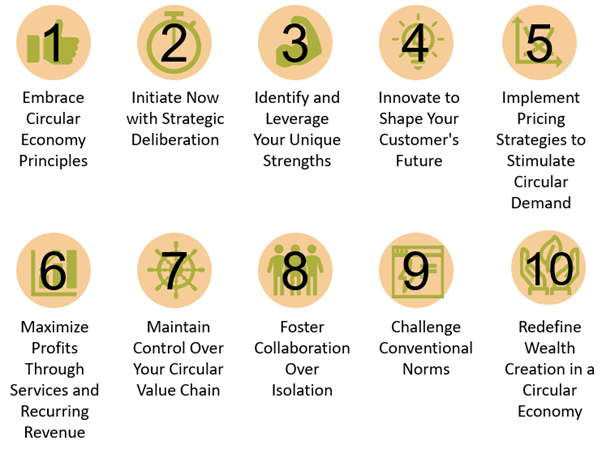
From Linear to Circular Economy
Understanding the fundamental shift in how products, materials and value flow through the economy
What it shows
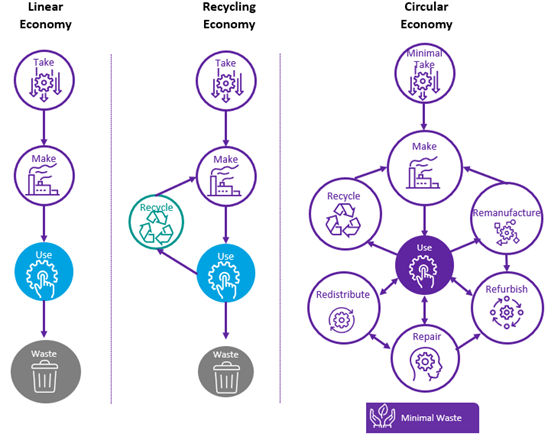
The framework illustrates the fundamental difference between three economic models: the traditional linear economy, the transitional recycling economy, and the circular economy.
In the linear model, resources follow a largely one-way path: take, make, use and dispose. The recycling economy improves this model by recovering some materials at the end of product life, but much of the underlying logic remains linear.
The circular economy changes the system itself. Products, components and materials are designed to remain valuable and in circulation for as long as possible through reuse, redistribution, repair, refurbishment, remanufacturing and, ultimately, recycling.
Why it matters for business
Moving from linear to circular is much more than improving waste management. It changes how companies design products, source materials, interact with customers, organize supply chains and generate revenue.
The important strategic shift is from viewing products and materials as something that eventually becomes waste to viewing them as assets whose value can be retained and captured repeatedly.
This creates opportunities to reduce dependence on virgin resources, strengthen supply-chain resilience, extend product lifetimes and develop new revenue streams around products already in the market.
How companies can use the framework
Companies can use the framework as a simple starting point for examining where their business sits today and where opportunities for greater circularity exist.
For example, management teams can map major products against the three models and ask:
- Are we primarily selling products and losing control of them after the initial sale?
- Are our circular initiatives mainly focused on recycling waste?
- Could products or components instead be reused, repaired, redistributed, refurbished or remanufactured?
- Could materials recovered from existing products become future production inputs?
- Where could keeping products in circulation create additional customer value and revenue?
Key question
Where are we currently destroying value that could instead be retained, recovered or monetized?
The 1+5 Rs: A Blueprint for Circular Manufacturing
A practical model for redesigning products, business models and operations for the circular economy
What it shows
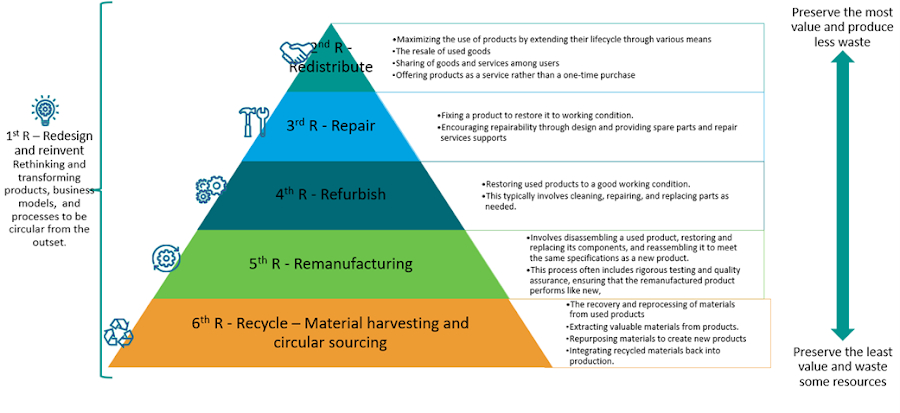
The 1+5 Rs model provides manufacturers with a structured way to move from circular ambition to concrete business opportunities.
It starts with Redesign and Reinvent as the foundation: products need to be designed for adaptability, repairability, upgrading, disassembly and extended use, while business models must evolve to support these characteristics.
From there, five circular business strategies can be developed: Redistribute, Repair, Refurbish, Remanufacture and Recycle.
Together, these strategies help manufacturers extend product lifecycles, keep products and components at their highest possible value, and recover resources when further use is no longer feasible.
Why it matters for business
Circularity is not a single business model.
A manufacturer may create value through several circular pathways during the life of the same product: selling it, servicing it, repairing it, redistributing it, refurbishing it, recovering components through remanufacturing and eventually recycling its materials.
The 1+5 Rs therefore provides a portfolio perspective on circular value creation. It helps companies identify where additional revenue, customer engagement, cost savings and resource value can be captured beyond the initial product sale.
Importantly, manufacturers do not necessarily have to perform every activity themselves. Their products and business models should instead be designed to participate effectively in a broader circular business ecosystem involving logistics providers, repair companies, refurbishers, distributors, recyclers and other partners.
How companies can use the framework
Companies can use the 1+5 Rs as a strategic workshop tool to examine each product line and identify where circular business opportunities exist.
Management teams can ask:
- Redesign & Reinvent: Can the product and business model be redesigned for longer life, modularity, upgrades and multiple use cycles?
- Redistribute: Can products, modules or components be resold, reused or transferred to new customers?
- Repair: Can repair become an accessible and profitable service rather than a cost or inconvenience?
- Refurbish: Can used products be restored and brought back to market with renewed value?
- Remanufacture: Can products be designed so valuable components can be recovered and reused in new production?
- Recycle: When further product or component reuse is no longer viable, can materials be recovered and reintroduced as productive resources?
The result can be used to identify new business models, product-design requirements, capability gaps, ecosystem partners and investment priorities.
Key question
How many times can we create and capture value from the same product, component or material before its economic value is exhausted?
When to Move: Navigating the Circular Economy Adoption Curve
A framework for balancing the risks of moving too early against the risks of being left behind
What it shows
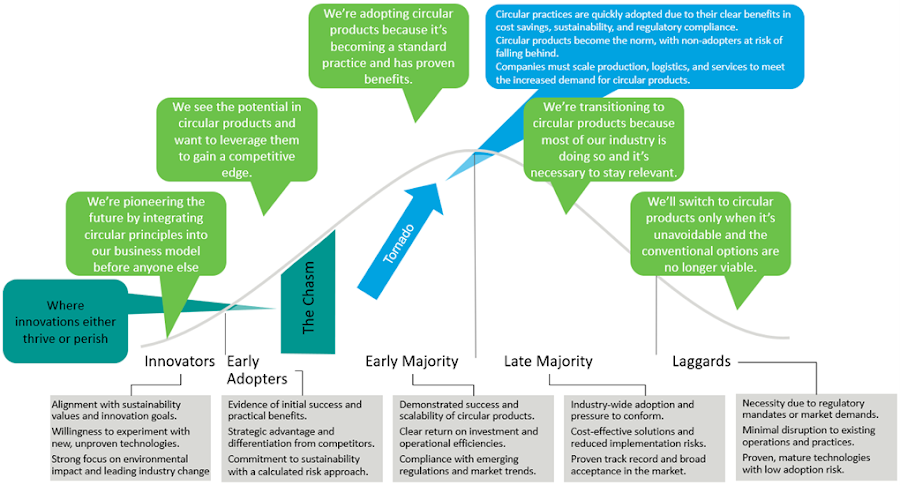
The innovation distribution curve illustrates how new technologies, practices and business models typically spread through a market: from innovators and early adopters, across the critical chasm, and into the early and late majority.
Applied to the circular economy, it helps explain why some companies experiment early with new circular products and business models, while others wait for technologies, customer expectations, regulations and market structures to mature. The decisive challenge is often crossing the gap between promising pilots and scalable, commercially viable solutions.
Why it matters for business
Circular transformation creates a difficult strategic timing question.
Move too early, and a company may invest before the market, technologies, infrastructure or customers are ready. Move too late, and competitors may already have established capabilities, customer relationships, ecosystem positions and market leadership.
The framework therefore helps companies balance two competing risks: Fear of Missing Out (FOMO) and Fear of Being Early (FOBE). The goal is not simply to be first, but to understand when experimentation should become commitment and when a circular initiative is ready to scale.
How companies can use the framework
Companies can use the curve to position individual circular initiatives according to their level of market maturity.
For each initiative, management can assess questions such as:
- Are we still experimenting, or has the business model been sufficiently validated?
- Are customers ready to adopt the circular proposition?
- Is the supporting technology and infrastructure mature enough?
- Are regulatory developments likely to accelerate market adoption?
- Have competitors already begun building scale?
- What evidence would justify moving from pilot to full-scale implementation?
The framework is particularly useful for managing a portfolio of circular initiatives. Some opportunities may justify early experimentation, while others should be monitored until market conditions become more favorable.
Key question
Are we waiting because the market is genuinely not ready — or because our organization is reluctant to move?
The Circular Economy Strategy Framework
A structured way to turn circular economy ambitions into strategic choices and business priorities
What it shows
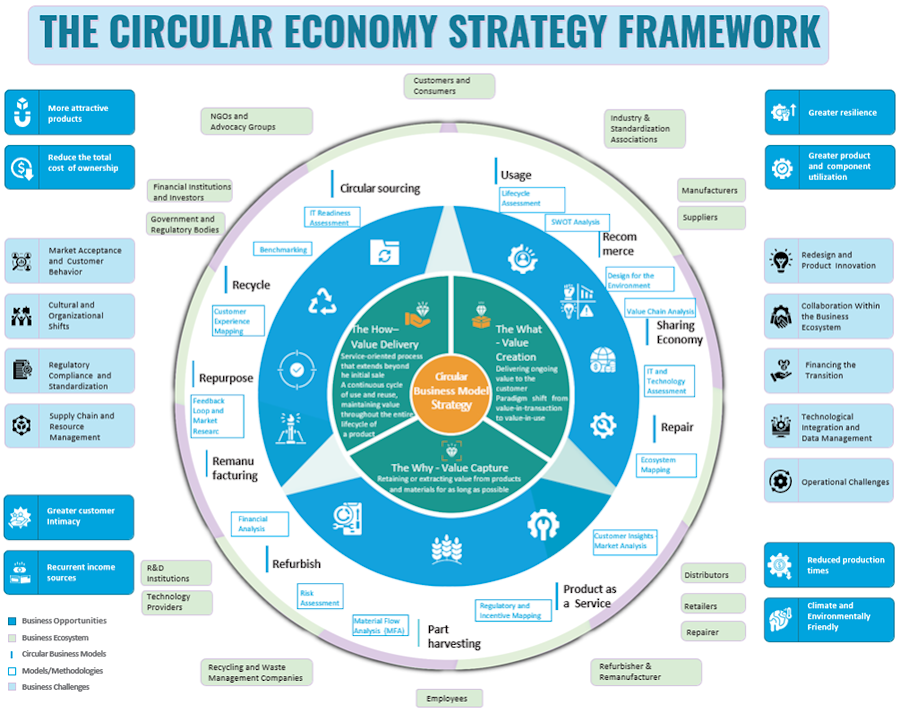
The Circular Economy Strategy Framework helps companies connect circular economy opportunities with their broader business strategy.
Rather than treating circularity as a separate sustainability initiative, the framework encourages companies to evaluate where circular principles can strengthen competitiveness, create new revenue streams, reduce resource dependency and improve long-term resilience.
It provides a structured way to move from broad circular ambitions to concrete strategic choices.
Why it matters for business
Many companies understand the relevance of circular economy but struggle with a more difficult question: where should we actually focus?
Not every circular opportunity is equally attractive, and not every initiative should be pursued at once. Companies need to assess where circularity can create the strongest combination of customer value, business value and strategic advantage.
The framework helps management prioritize opportunities that fit the company’s capabilities, market position and long-term objectives.
How companies can use the framework
Companies can use the framework during strategy development, portfolio reviews or circular transformation programs.
Management teams can use it to:
- Identify the most relevant circular opportunities across products, services and value chains.
- Evaluate which opportunities support existing strategic priorities.
- Distinguish incremental improvements from opportunities that require fundamentally new business models.
- Identify capability gaps, partnerships and investments needed to execute.
- Prioritize initiatives based on strategic attractiveness and feasibility.
- Create a coherent circular economy roadmap rather than a collection of disconnected projects.
The framework is particularly useful for bringing different functions together. Strategy, product development, operations, sustainability, digital, finance and commercial teams can use the same structure to evaluate circular opportunities from a common business perspective.
Key question
Where can circularity create a meaningful competitive advantage for our business — rather than simply improve our environmental performance?
The Economics of Circular Products
How circular business models create value repeatedly instead of relying on a single sale
What it shows
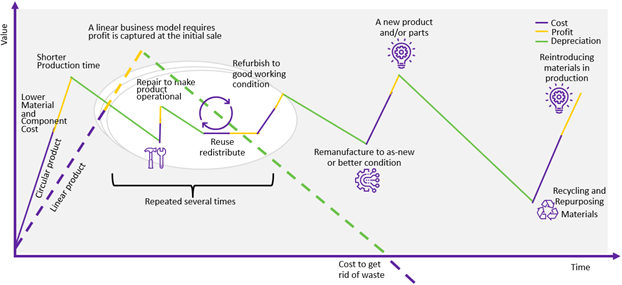
The framework compares the economic trajectory of a traditional linear product with that of a circular product over time.
A linear product typically generates most of its revenue at the initial sale. From that point onward, its economic value declines, eventually reaching the stage where disposal can create an additional cost.
A circular product follows a different path. It can create value repeatedly through repair, redistribution, refurbishment, remanufacturing and, ultimately, recycling or repurposing. The result is a series of additional value and revenue opportunities across the product lifecycle rather than a single point of value capture.
Why it matters for business
The framework challenges one of the fundamental assumptions of the linear economy: that profitability is primarily created when a new product is sold.
In a circular business model, the same physical product, component or material can contribute to revenue and profit several times.
Circular models may also reduce material and component costs through reuse and remanufacturing, shorten production time, and create recurring revenue streams through services and lifecycle activities. This means that even where the initial selling price is lower, the total profitability across the product lifecycle can be higher.
This also changes the financial logic of the business. Circular models can involve greater upfront investment and more deferred income, because revenues increasingly accumulate throughout the product’s life rather than exclusively at the first sale.
How companies can use the framework
Companies can use the framework to rethink how they calculate the value of products and business models.
Instead of asking only: “What margin do we make when we sell this product?” management can evaluate the full lifecycle:
- What revenue can be generated from maintenance and repair?
- Can the product be taken back and resold?
- Can it be refurbished and sold into another customer segment?
- Can valuable components be harvested and remanufactured?
- Can recovered materials reduce future production costs?
- Can service, subscription or Product-as-a-Service models generate recurring income?
- What costs arise at end-of-life, including possible Extended Producer Responsibility obligations?
This makes the framework particularly useful for business-case development, product portfolio management, pricing decisions and lifecycle profitability analysis.
Key question
Are we optimizing the profit from the first sale — or the total profit the product can generate throughout its entire life?
The Sustainable Manufacturing Intelligence Framework
The digital capabilities manufacturers need to make circular business models work at scale
What it shows
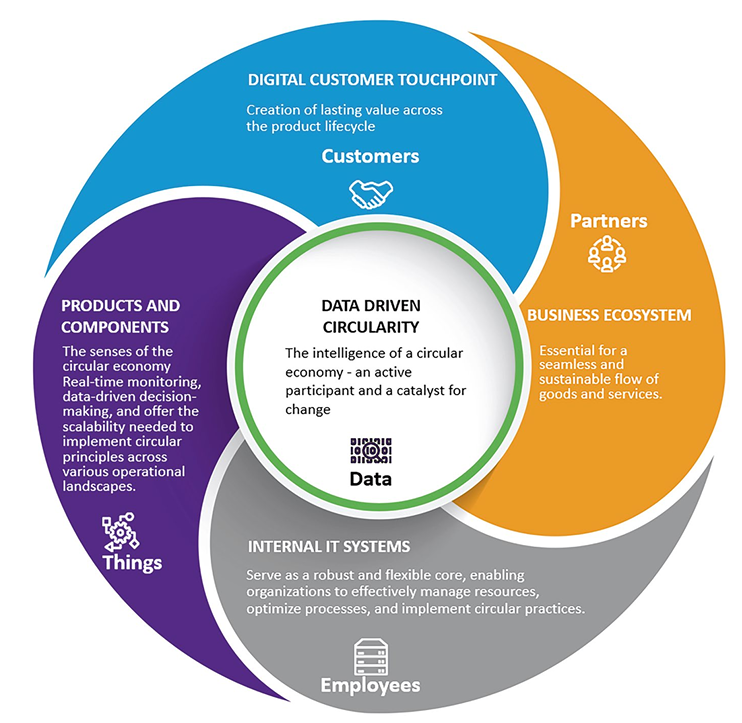
The Sustainable Manufacturing Intelligence Framework, or SMIF, identifies five digital capability areas that manufacturers need to support circular business models: Internal IT systems, Digital business ecosystems, Connected products, Digital customer touchpoints and Data-driven circularity.
Together, these capabilities create the digital foundation for managing products, customers, partners and data throughout extended product lifecycles. The framework is intended to guide manufacturers through the digital transformation required to embed circular principles into their operations.
Why it matters for business
Circular business models are significantly more information-intensive than traditional linear models.
Once a manufacturer wants to repair, redistribute, refurbish, remanufacture or retain responsibility for a product, it needs to know much more about that product throughout its life: where it is, who is using it, its condition, its service history, what components it contains, and what should happen to it next.
The company must also remain connected with customers after the original sale and coordinate with external partners such as repair providers, logistics companies, marketplaces, refurbishers and recyclers.
Digitalization therefore becomes an enabler of circularity, rather than merely an efficiency tool.
How companies can use the framework
Companies can use SMIF as a capability map to assess whether their digital foundation is ready to support their circular ambitions.
Management teams can examine the five areas:
- Internal IT systems — Can ERP, CRM, supply-chain and product systems support take-back, traceability, multiple product lifecycles and circular transactions?
- Digital business ecosystems — Can the company exchange information and coordinate processes effectively with external circular-economy partners?
- Connected products — Can products provide information about their location, use, condition and performance throughout their lifecycle?
- Digital customer touchpoints — Can the manufacturer maintain the customer relationship beyond the initial sale and make repair, return, resale, upgrades and other circular services easy to access?
- Data-driven circularity — Can data from products, customers, partners and internal systems be combined and converted into insights that improve profitability, resource efficiency and decision-making?
The fifth capability is especially important. In the framework, data-driven circularity acts as the intelligence layer, integrating information from the other four areas and using analytics, AI, machine learning and related technologies to improve circular operations and strategic decisions.
Key question
Do we have the digital capabilities to manage a product after we have sold it?
The 10-Step Circular Advantage Guide
A practical roadmap for turning circular economy principles into competitive advantage
What it shows
The 10-Step Circular Advantage Guide brings together the main strategic lessons from the book into a practical roadmap for manufacturers.
Its purpose is to help companies move beyond isolated circular initiatives and build a more coherent transformation covering strategy, product design, business models, capabilities, digitalization, ecosystems, customer engagement and execution.
The guide is explicitly intended as a roadmap for manufacturers seeking to implement circular economy principles and translate them into long-term business value.
Why it matters for business
The transition to a circular economy is not achieved through a single initiative.
Launching a take-back scheme, increasing recycled content or improving repairability can all be valuable, but these measures alone do not necessarily create a circular business.
Circular transformation requires companies to align multiple parts of the organization around a common direction. That includes: strategy, products, operations, customers, partners, technology, data, organizational capabilities and financial priorities.
The 10-Step Circular Advantage Guide therefore helps management view circularity as a business transformation agenda rather than a collection of sustainability projects.
Its ultimate objective is not circularity for its own sake, but the creation of a business that is more competitive, resilient, resource-efficient and capable of generating new forms of value. The book describes the guide as a way to build a sustainable, resilient and profitable business model based on circular economy principles.
How companies can use the framework
Companies can use the 10 steps as a structured roadmap for their circular transformation.
Management teams can use it to:
- Establish a shared understanding of circular economy principles.
- Identify where circularity can create strategic business value.
- Redesign products and business models around longer and multiple lifecycles.
- Develop the organizational capabilities required to support circular operations.
- Determine where ecosystem partners are needed.
- Strengthen digital capabilities and product lifecycle visibility.
- Engage customers in new circular propositions.
- Align investments and priorities with the circular strategy.
- Define measurable objectives and track progress.
- Continuously adapt as technologies, regulations and markets evolve.
Rather than requiring every company to follow exactly the same transformation path, the guide can be used to identify where the organization is today, which capabilities are missing, and what it should address next.
Key question
What must change across our business for circularity to become a competitive capability rather than an isolated initiative?